Aligning celestial paths...
Graphology & Signature Science
Reveal Your Personality Through Handwriting
Your handwriting shows what is happening inside your mind. The way you write — your letter shapes, slant, and pressure — reflects your personality, habits, and emotions. By changing how you write (Graphotherapy), you can actually improve your mindset and behavior.
Interactive Signature Scanner
Draw your signature here using your mouse or touch screen to analyze it in real-time.
Scanner Analytical Metrics
Draw on the scanner pad above. The system will automatically analyze slants, baseline drift, and pressure speed as you sign.
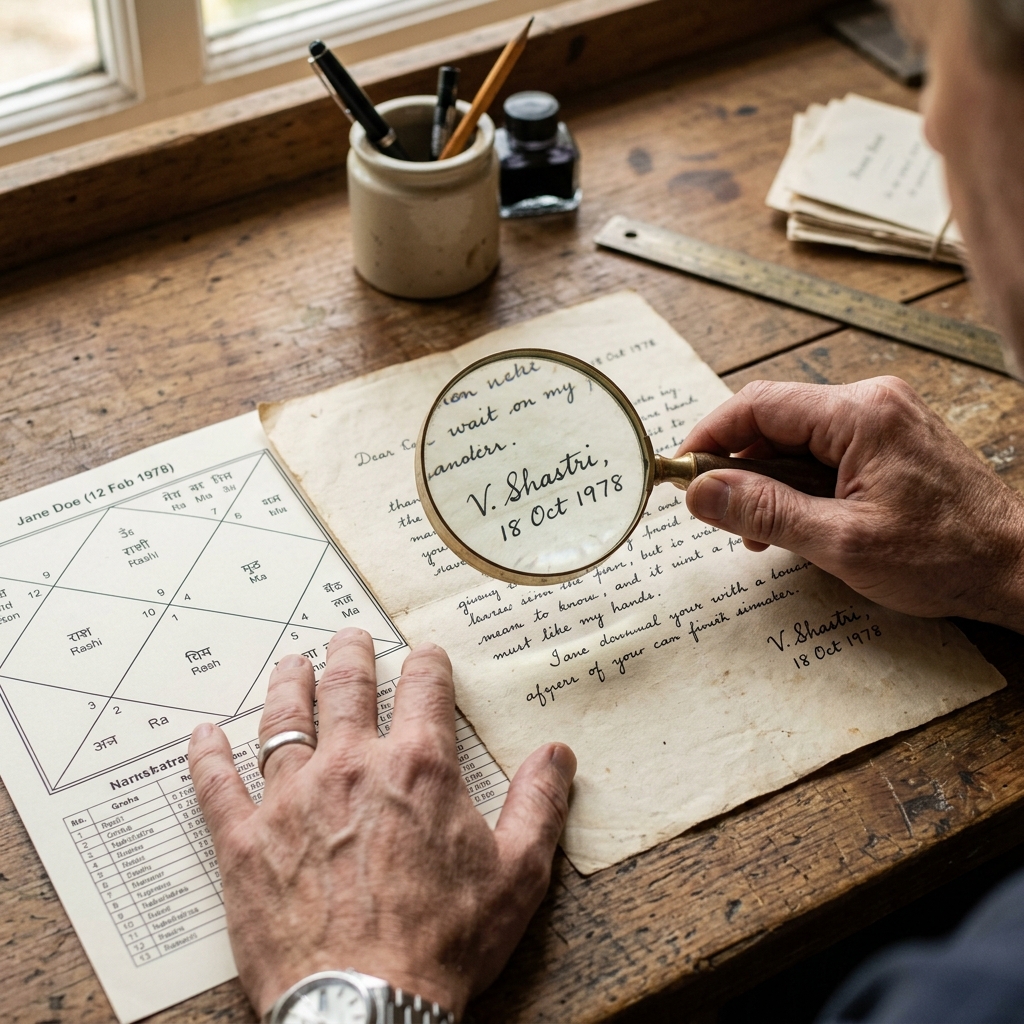
Brain-Writing: The Science
When you write, your brain sends signals to your hand muscles. Every stroke, space, curve, and angle you make is not just habit — it reflects your thoughts, emotions, and personality at that moment.
When you practice correcting specific strokes — like how you cross your 't's, dot your 'i's, or write your signature — those corrections send new signals back to your brain and slowly change your habits and thinking patterns over 21 days. This is called Graphotherapy.
Specialized Guides
Explore Graphology Deep-Dives
Signature Analysis Science →
Public persona, underlines, strike-throughs & social confidence.
Handwriting Slant Psychology →
Right, left, and vertical slant emotional responsiveness.
21-Day Graphotherapy Protocol →
Neurological habit rewiring through somatic penmanship.
Letter Micro-Analysis ('t', 'i', 'g') →
Willpower, attention to detail, intimacy, and ambition.
Pen Pressure & 3 Writing Zones →
Upper, middle, and lower zone energy distribution.
Handwriting Stroke Indicators
Handwriting Slant
Emotional ResponseSlanting right means you are emotionally expressive and social. Writing straight up means you are calm and logical. Slanting left means you tend to keep feelings to yourself.
Writing Pressure
Energy & MemoryWriting with heavy pressure shows strong energy and good memory. Light pressure shows sensitivity and flexibility. How hard you press reveals your inner vitality.
Three Writing Zones
Focus AreaThe top part of letters shows thinking and ideas. The middle part shows daily life and social habits. The bottom part shows physical and material concerns.
Letter Spacing
Social DistanceWide spacing between letters shows generosity and open-mindedness. Close spacing shows caution and preference for a small trusted circle.
Micro-Analysis of Letter Formations
Specific letters in your writing reveal your habits, confidence level, and how you think.
Intellect & Willpower Indicators ('t' and 'i')
• Letter 't' Crossbar Height: A crossbar placed high on the stem indicates high goals and strong AMCition. A low crossbar indicates lower self-esteem or fear of failure.
• Letter 't' Crossbar Weight/Length: A long, firm crossbar represents lasting willpower and determination. A weak, thin bar indicates poor follow-through or physical fatigue.
• Letter 'i' Dot Placement: Dot placed close to stem indicates excellent memory and attention to detail. Dot placed high above stem represents imagination and idealism. Circles instead of dots suggest creative individualism, while dashes indicate impatience.
Emotional & Material Loops ('g', 'y', 'o')
• Lower Loops ('g' and 'y') Size: Large, full loops represent a strong physical drive, interest in material security, and relationship warmth. Narrow or straight vertical lines indicate emotional detachment or reservation.
• Lower Loops Closure: A loop that closes fully and returns to the baseline represents relationship trust. Loops that stay open indicate a tendency to leave emotional business unfinished.
• Inner Loops in Vowels ('o' and 'a'): Small loops on the inside of these characters suggest keeping secrets or withholding thoughts. Clean, loop-free circles suggest straightforward, direct communication.
Signature Analysis Guide
Your signature is your public persona—how you present yourself to society. Contrasting the signature against normal writing slants reveals discrepancies between public projections and private realities.
• Bottom Underline: Indicates self-reliance, leadership, and emotional stability.
• Strike-Through Signature: Crossing out one's own name indicates self-criticism or subconscious self-sabotaging habits.
• Sizing Ratio: A signature significantly larger than the text indicates a desire for social recognition. A smaller signature indicates privacy and humility.
Margins & Spacing Psychology
How you use space on a page represents how you handle space in your life, reflecting social comfort and boundaries.
• Left Margin (Past & Family): A wide left margin indicates a desire to move forward and leave the past. A narrow left margin suggests attachment to roots and domestic habits.
• Right Margin (Future & Society): Wide right margin reveals a fear of the unknown or reservation in social groups. Narrow right margin indicates enthusiasm to explore future opportunities.
• Word Spacing: Large spaces represent a need for personal freedom and boundaries. Tight spaces indicate a preference for close contact and constant activity.
How Graphotherapy Works
1
Write & Submit
Write a standard 1-page unruled letter, sign it, and submit a photo during your scheduled consultation.
2
Microscope Analysis
We analyze slant, margins, pressure, connections, spacing, and starting/ending stroke characteristics.
3
Stroke Training
Receive custom stroke exercises (Graphotherapy) to write daily for 21 days to retrain your habit patterns.
The 21-Day Graphotherapy Protocol
Follow these structured steps to reprogram subconscious cognitive habit loops through somatic writing.
Days 1 - 5: Isolation
Practice the isolated strokes recommended by your graphologist (e.g. loops in 'g', high crosses in 't') for 10 minutes on a blank sheet. Focus entirely on the physical movement.
Days 6 - 12: Integration
Begin writing full paragraphs, consciously integrating the adjusted letters into standard words. Writing speed will slow down as your motor cortex forms new paths.
Days 13 - 18: Flow State
Write freely without looking at the pen. Speed up your penmanship. The brain starts running the new neural pathway automatically without requiring active conscious control.
Days 19 - 21: Consolidation
Test your signature slant under speed or distraction. The new strokes consolidate into long-term muscle memory, completing the cognitive habit reprogram loop.
Frequently Asked Questions
What is graphology?
Graphology is the scientific analysis of handwriting to determine psychological patterns, emotional state, and personality traits. Your brain writes, not your hand, making handwriting a form of "brainwriting."
How does handwriting analysis work?
A graphologist analyzes elements like slant, size, baseline, pressure, margins, and the specific shapes of letters (like "t" and "y"). Each element corresponds to a specific neurological habit and personality trait.
Can graphology predict the future?
No, graphology cannot predict the future. It provides a deep psychological profile of who you are right now, highlighting your strengths, weaknesses, fears, and relationship patterns.
What can graphology tell me about my personality?
It reveals over 100 traits including your level of self-esteem, how you process information, your emotional responsiveness, your drive to achieve, and how you handle stress or relationships.
Is graphology scientific?
Graphology is an empirical science. It relies on the consistency of neurological muscle movements that reflect brain patterns. It is widely used in Europe for recruitment and clinical psychology.
What is Graphotherapy?
Graphotherapy is the science of changing your personality by consciously altering specific strokes in your handwriting. By practicing new strokes for 21 days, you form new neural pathways in your brain.
What do you need for a graphology consultation?
We require a one-page sample of your handwriting on an unruled, blank sheet of paper, written with a ballpoint pen. It must be written naturally and signed at the bottom.
Can graphology detect lies?
Graphology cannot tell if a specific statement is a lie, but it can identify if a person has deceptive tendencies, is highly secretive, or rationalizes their actions.
Can it help with career choices?
Yes. By analyzing your drive, focus, and social adaptability, we can determine if you are better suited for analytical work, sales, leadership, or creative professions.
Is signature analysis different from handwriting analysis?
Yes. Your handwriting reveals your true inner self, while your signature reveals your public persona (how you want the world to see you). Discrepancies between the two are very revealing.
Explore Interconnected Guides & Calculators
Discover Deeper Insights Across Occult Sciences
Combine Astrology, Numerology, Graphology, and Tarot for a 360-degree understanding of your life path.
Free Calculators
Consultations
2026 Transits
Experiencing life challenges? Book a personal video consultation with our senior consultants.
Book 1-on-1 SessionBook Graphology Consultation
Select your consultation type, date and preferred slot dynamically synced with Google Calendar.